Waruno Mahdi’s
List of Linguistic Publications
(see also List of Presentations)

Waruno Mahdi’sList of Linguistic Publications(see also List of Presentations) |
|

n.d. return to top Origins and Affiliations of the Austronesians,
proposed monograph.“Amok”,
accepted for publication in the compendium KulturTransfer, ed. by Raoul Schrott et al., Hanser Verlag.“Historiographic observations about Pre-Malayo-Polynesian westward migrant movements across the Indian Ocean”,
submitted as contribution to a Festschrift.“The Role of Internet in the 1998 downfall of Indonesia’s Soeharto regime”,
submitted.
2020 return to top Review of Jürg Schneider (2019, Vom Gebrauch der Philologie: Der Luzerner Sprachforscher Renward Brandstetter (1860–1942). Wiesbaden: Harrassowitz Verlag).
Bijdragen tot de Taal-, Land, en Volkenkunde 176: 414–416 (2020).
DOI 10.1163/22134379-17601015
2018 return to top “The First Standard Grammar of Malay: George Werndly’s 1736 Maleische Spraakkunst”, Wacana, Journal of the Humanities of Indonesia 19: 257–290.
Online at wacana.ui.ac.idA brief biography of Werndly, and some notations about antecedent studies of Malay grammar and Christian religious texts. The main part is a detailed perusal of Werndly’s 1736 Malay grammar, in particular the divisions on spelling, morphology, syntax.
2017 return to top A rediscovered 1696 decree poster of the Governor General in Batavia, with unexpected stylistic particularities, Archipel 93: 84–108 (2017).
Online at archipel.revues.org/402A 1696 decree forbidding the opening of new sugar, arrack, lime, and brick production sites for reason of scarcity of firewood was generally disobeyed. Its official poster was not archived, but ended up in a foreign library, where it was recently rediscovered, presenting a unique original full-length official text of that time. This allows inspecting the language style that remained obscure in reedited publications of official documents, providing unexpected socio-linguistic insights into particularities of relations between VOC functionaries and the home office.Pre-Austronesian origins of seafaring in Insular Southeast Asia.
Chapt. 8 in: Andrea Acri, Roger Blench & Alexandra Landmann (eds.), Spirits and Ships: Cultural Transfers in Early Monsoon Asia, pp. 325–374. Singapore: ISEAS Publishing (see contents)
ISBN 978-981-47-6275-5
Web reference: bookshop.iseas.edu.sg/publication/2214This paper proceeds from the results of my 2016 paper (cited immediately below), inspecting the role of Negritos — after contacting with populations of the East-Asian mainland — in the development pf shipping and maritime communication. The Trans-South-China-Sea-Network is inspected as beginning of maritime proto-globalization, and the development of boat burial and ship-of-the-dead cult. Further advancement of maritime proto-globalization is followed westwards across the Bay of Bengal, particularly the chronological phases of transmission of the banana to India and further, as also of the coconut.
2016 return to top Origins of Southeast Asian Shipping and Maritime Communication across the Indian Ocean.
Chapt. 2 in: Gwyn Campbell (ed.), Early Exchange between Africa and the Wider Indian Ocean World, pp. 25–49, Palgrave Series in Indian Ocean World Studies. Palgrave Macmillan. Springer Nature.
ISBN 978-3-319-33821-7; DOI 10.1007/978-3-319-33822-4
[Download chapter as PDF (756 KB)]This paper brings together archaeological, genetic, ethnographical, and linguistic data, to show that: (1) Sunda-Sahul not only presents a unique environment for primeval development of maritime mobility, but this latter (with rafts) indeed developed here more than twice as long ago than elsewhere in the world; (2) the double canoe was apparently developed from a raft via a multiple canoe by Southeast Asian Negritos while fleeing before the rising sea level (Late Pleistocene till Middle Holocene); (3) these Negritos introduced the double canoe to both mainland Chinese and Malayo-Polynesians, and apparently carried out earliest forms of maritime trade in the South China Sea area; and (4) people of the first wave of the “Malayo-Polynesian” migration were of an Australoid phenotype.Linguistic variety in later nineteenth-century Dutch-edited Malay publications.
In: Yanti & Tim McKinnon (eds.), Studies in language typology and change. NUSA 60: 107–185.
[online at Tokyo University of Foreign Studies (TUFS)]Malay publications in colonial Indonesia (Netherlands East Indies) up to 1800 were mainly by Dutch missionaries. Publications after 1900 covered a wide scope of mostly secular topics and genres, edited by indigenous Indonesians (besides Sino-Indonesians and Dutch). This article studies the intervening period that is characterized by far-reaching secularization and wide thematic diversification, revealing at the same time a lack of coordination of language expertise, resulting in a high degree of dialectal and spelling variation. The development will be inspected in missionary publications, legal documents, schoolbooks, Dutch-edited Malay newspapers and popular literature. It suggests a close correlatedness between the informal Malay of Dutch editors and of the educated indigenous elite.
2015 return to top 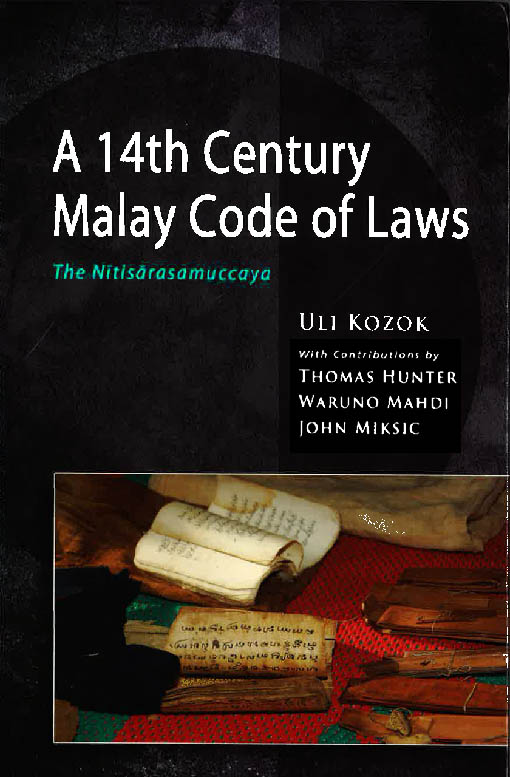 Script and Language of the Tanjung Tanah Manuscript, pp. 162–220, &
Transliteration and Normalized Transcription, pp. 64–73, &
(with T. Hunter & U. Kozok) Translation, pp. 74–79.
In Uli Kozok, A 14th Century Malay Code of Laws: The Nīttisārasamuccaya,
with contributions by Thomas Hunter, Waruno Mahdi, John Miksic.
Singapore: Institute of Southeast Asian Studies (ISBN: 978-981-4459-74-7);
Index of eBook sections
Online google-book repro up to p. 83.Abstract coming soon
2013 return to top À propos de “The Problems of the Ancient Nama Java and the Role of Satyavarman in Southeast Asian International Relations Around the Turn of the Ninth [sic] Century CE”, Archipel 86: 229–234 (2013).Reply to uncivil and libelous contentions against me by the author of an article with above-cited title, which had appeared in an earlier issue of the journal.
2012 return to top Distinguishing Cognate Homonyms in Indonesian, Oceanic Linguitics 51: 402–449 (2012).
[online at Project MUSE]Cognate homonyms in standard Indonesian Malay can result from semantic shift, derivational conversion, or idiomatization. One problem in considering such homophonous expressions is how to differentiate between a compound word, a fixed expression, and a free phrase. Particular instances are compound and noncompound expressions having a monosyllabic component that is a clitic when not in a compound. Another source of cognate homonyms is the conversion of verb forms into nouns, or distinct word forms involving identical affixes. Finally, there are homonyms that result from grammaticalization or degrammaticalizationRenward Brandstetter’s comparative analysis of the ‘Indonesian Mind’. In: Robert Blust and Jürg Schneider (eds.), A World of Words: Revisiting the Work of Renward Brandstetter (1860–1942) on Lucerne and Austronesia, Frankfurter Forschungen zu Südostasien 8, pp. 105–132. Wiesbaden: Harrasowitz.Review of Gerd R. Zimmermann (2010, Die Besiedlung Madagaskars durch <Indonesier>. Nackenheim/Rh: Edition Matahari).
Internationales Asienforum / International Quarterly for Asian Studies 43: 138–140 (2012).Review of John U. Wolff (2010, Proto-Austronesian Phonology with Glossary, vols. I-II. Ithaca [NY]: Southeast Asia Program Publications, Cornell University), Archipel 83: 214–222 (2012).Bifurcation of Commercial Tradition in West Indonesia, 1850–1930, as Reflected in Contemporaneous Malay Print Publishing.
Asian Journal of Social Science 40: 100–132 (2012).
[DOI = 10.1163/156853112X632557]Divided in 4 sections: (1) the Austronesian commercial tradition, and precolonial emergence of financial tradition up to dissolution of the VOC in 1799; (2) indigenous shipping and trade throughout the 19th and half the 20th centuries; (3) divergent development of industrial-age forms in indigenous trade and finance since c. 1850, particularly as reflected in commercial advertisements; (4) some post-1930 consequences of the belated modernisation in trade and finance, and the gradual overcoming of the developmental ambiguity after 1945.
2010 return to top Comment, pp. 242–243 in:
Mark Donohue and Tim Denham, Farming and Language in Island Southeast Asia: Reframing Austronesian History, Current Anthropology 51:223–256 (2010).
2009 return to top In search of an historical Sea-People Malay dialect with -aba-. In Alexander Adelaar and Andrew Pawley (eds.), Austronesian historical linguistics and culture history: a festschrift for Robert Blust, Pacific Linguistics 601, pp. 73–89. Canberra: Research School of Pacific and Asian Studies, Australian National University.The parent language of modern Moken and Moklen—named “Pre-Moken”—is identified as the source of early Chinese and Arabic (and Greek) renderings of the name of Yava[dvipa] that suggest a precursor form with -aba- in place of the original -ava- (rendered -awa- in Malay). The identification also helps explain a number of irregular instances of the sequence -aba- in Malay and some other languages. Besides Pre-Moken speakers, other Sea-People communities seem to have ben involved as well in Malay shipping on various routes.A Symposium on Malay/Indonesian Linguistics, “Hot” and “Cool” Languages, “Dressed” and “Undressed” Ones, and More (Leiden, 26–28 June 2008), Archipel 77:3–7.Report for Échos de la recherche about the Twelfth International Symposium on Malay/Indonesian Linguistice (ISMIL 12) in Leiden.Review of Ricky Ganang, Jay Crain, Vicky Pearson-Round (2008, Kemaloh Lundayeh - English Dictionary, Borneo Research Council Reference Series No. 1. Phillips [ME]: Borneo Research Council), Archipel 77:226–229.A remarkable dictionary, the significance of which goes far beyond being a very thorough dictionary of the language. It appears to be designed as mainstay of ethnic unity, culture identity and tradition of a marginal speech community dispersed as ethnic pockets in Sarawak, Sabah, and East Kalimantan. With this dictionary, the Lundayehs appear to come out to claim their part in the globalised world.
2008 return to top Review of Russell Jones (gen. ed., 2007, Loan-words in Indonesian and Malay, Compiled by the Indonesian Etymological Project. Leiden: KITLV Press), Archipel 76:318–322.An etymological dictionary of “Non-Nusantaran” (and Non-Austroasiatic) loan-words in Indonesian and Malaysian (literary and vernacular) Malay, resulting from the collective contributions of prominent international specialists in the field.Yavadvipa and the Merapi Volcano in West Sumatra, Archipel 75:111–143.Reconstructs three episodes in the history of Yavadvipa (emergence in Sumatra, conquest by Sri Vijaya, revival in Central Java), in which a Merapi volcano plays a role, the third one involving transfer of the originally Sumatran names Yava ~ Jawa and Merapi, to Java and a Javanese volcano.
The testimony of the Kedukan Bukit, Kota Kapur, Canggal, Ligor (Chaiya) steles A and B, and Cambodian Sdok Kak Thom inscriptions, the Sundanese Carita Parahiyangan, Vietnamese Annals, and several Chinese sources, are combined into a unified historical frame of relations between megalithist highland agriculturists, maritime seamen and traders, and lowland urban power centers, of sacral attributes of kingship and paramountcy, while offering possible answers to some puzzling aspects of early Indonesian history, the roles of Sumatra, Java and the Peninsula, the reign of King Sanjaya, and accession to power of the Shailendras in Sri Vijaya.
[Downloadable as pdf at Persee.fr]
2007 return to top 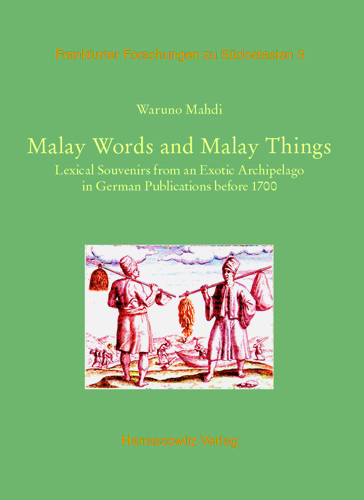 Malay Words and Malay Things: Lexical Souvenirs from an Exotic Archipelago in German Publications before 1700, Frankfurter Forschungen zu Südostasien 3. Wiesbaden: Harrassowitz Verlag (ISBN: 978-3-447-05492-8);
Google Book online repro
Bibliographic citation: Germanistik 48:64 (2007), downloadable as pdf of pp. 62–65.
Table of contents and list of illustrationsAims at a comprehensive review of writings of German authors and German translations of foreign publications, bringing information about the Malayan world and language to the German public before 1700. Begins with perusal of earliest bits of information, including earliest atlasses; considers the influence of changing economic and political circumstances in Germany on public interest in distant countries and uptake of foreign words; paths of transmission of lexic and graphic information; this also includes detailed etymological studies of individual words and citations of early usage of Malayisms; further development of acquired information and usage of loanwords also after 1700. Inspects insights into the contemporaneous linguistic situation in the Archipelago opened by the reviewed travel accounts, touching in particular upon developments involving Indies Dutch, the local Creole Portuguese, Baba Malay, and a local Chinese dialect that apparently developed in Chinese settlements in the Archipelago. Also touches upon contributions from or involvement of Arabic, French, Italian, Kannada, Malayalam, Persian, Spanish, and Tamil.
Augments or revises the etymologies of:
bolleponge, gecko, gomuti, kakerlak, junk (jung), lory (bird), orangutan, proa/prow, rattan, sloop/shallop, tea, a.o.
Reviewed writers, editors, translators, and publishers include:
Jürgen Andersen, Christoph Arnold, Gotthard Arthus, Johann von der Behr, Johann Theodore & Johann Israel de Bry, Theodore de Bry, Christian Burckhardt, François Caron, Olfert Dapper, Johann Deusing, Mathäus Dresser, Christoph C. Fernberger, Georg Chr. Fernberger, Sigmund Feyerabend, William Fitzer, Sebastian Franck, Erasmus Francisci, Christoff Frike, Henning Ghetelen, Johann L. Gottfried, Simon Grynæus, Mark Henning, Albrecht Herport, Michael Herr, Elias Hesse, Johann-Christian Hoffmann, Levinus Hulsius, Johann Huttich, Volquard Iversen, Johann Kellner, Conrad Lew, Johann A. Lonicerus, Johann Christoph Lorber, Johann A. von Mandelslo, Hieronymus Megiser, Georg Meister, Matthäus Merian, Johann Jacob Merklein, Heinrich Muche, Johann Neuhof (= Joan Nieuhof), Eliud Nicolai, Adam Olearius, Daniel Parthey, Fernão Mendez Pinto, Marco Polo, Augustinus Cassiodorus Reinius, Gregor Reisch, Jobst Ruchamer, Johann Jacob Saar, Hartmann Schedel, Caspar Schmalkalden, Joost Schouten, Wouter Schouten, Johann Schreyer, Christoph Schweitzer, Karsten Smedeken, Balthasar Sprenger, Bilibaldus Strobæus, Jean B. Tavernier, Ludovico de Varthema, Johann Verken, Johann Wilhelm Vogel, Johann Fridrich von Wida (= Jan Weerda), Johann H. Widerhold, Johann Sigmund Wurffbain.
Also consulted and/or quoted:
Muhammad ibn-Abdallah ibn-Battuta, Jacobus Bontius, Thomas Bowrey, Pieter van den Broecke, Carolus Clusius, Nicolò Conti, William Dampier, Sebastiaen Danckaerts, Francis Drake, Thomas Forrest, Johann Reinhold Forster, Alexander Hamilton, Frederik Hasselquist, Justus Heurnius, Cornelis de Houtman, Frederick de Houtman, Johann Theodor Jablonski, Friedrich Gottlieb Klopstock, Christoph Langhanß, Melchior Leydekker, Jan Huygen van Linschoten, Willem Lodewyksz., Abdullah bin Abdulkadir Munsyi, Jacob Cornelisz. van Neck, Henry Neville, Garcia da Orta, Joachim Perinet, Gottlieb Conrad Pfeffel, Antonio Pigafetta, Willem Piso, François Pyrard de Laval, Zakariya al-Qazwini, Pedro Fernández de Queirós, Nuruddin ar-Raniri, Seyger van Rechteren, Joannes Roman, Georg Eberhard Rumphius, Kaspar Stieler, David Tappe, Nicolaus Tulpius, François Valentyn, Georg H. Werndly, Wigardus à Winschooten, Martin Wintergerst, Johann Heinrich Zedler, as well as the Hikayat Bayan Budiman, Hikayat Hang Tuah, Hikayat Seri Rama, Sejarah Melayu, and the Syair Sinyor Kosta.
Supplemented:
the oldest Malay-German wordlist (of 1601) with annotations; also list of first usages of 28 German words.Reviews:Online reviews: Book News Inc. Portland (OR) · buchhandel.de.
- Marlies Salazar, in Archipel 75:247–250 (2008);
- Edwin Wieringa, in Bijdragen tot de Taal-, Land- en Volkenkunde 164:161–163 (2008).
2006 return to top The beginnings and reorganization of the Commissie voor de Volkslectuur (1908 – 1920). In Fritz Schulze and Holger Warnk (eds.), Insular Southeast Asia: Linguistic and Cultural Studies in Honour of Bernd Nothofer, pp. 85–110. Wiesbaden: Harrassowitz (ISBN: 978-3-447-05477-5).
[online repro of review by Franz Mueller, Oc.Ling. 47, 468-469 (2008)]Discusses some particularities of the publishing policy of the Commissie, later known as Balai Pustaka, during the first decade of its activity, and the significance of its reorganization in 1917-1920, also some possible long-term consequences of that for the language culture of postwar Indonesia.Collaboration in:
Uli Kozok, Kitab undang-Undang Tanjung Tanah: Naskah Melayu yang Tertua. Yayasan Naskah Nusantara. Alih Aksara: Hassan Djafar, Ninie Susanti Y., dan Waruno Mahdi. Alih Bahasa: Achadiati Ikram, I Kuntara Wiryamartana, Karl Anderbeck, Thomas Hunter, Uli Kozok, dan Waruno Mahdi. Jakarta: Yayasan Obor Indonesia (ISBN: 979-461-603-6).Annotated text of the 14th-century (oldest) Malay manuscript, discovered at Tanjung Tanah (Kerinci, Sumatra), preceded by an elaborate discussion.
2005 return to top Malagasy. In Philipp Strazny (ed.), Encyclopedia of Linguistics, pp. 641–644. New York & Oxon: Fitzroy Dearborn (ISBN: 978-1579583910).2000-word encyclopaedia entry.Old Malay. In Alexander Adelaar & Nikolaus P. Himmelmann (eds.), The Austronesian Languages of Asia and Madagascar, pp. 182–201. London & New York: Routledge (ISBN: 978-0-7007-1286-1).
[online repro at GoogleBooks]A detailed but concise account of the language of Old Malay stone inscriptions.
2002 return to top Review of H. Steinhauer (2001, Leerboek Indonesisch. Leiden: KITLV Uitgeverij), Oceanic Linguistics 41:525–528.
[online repro at JSTOR]A textbook in Dutch for tertiary Indonesian language courses from the university where Indonesian studies started (the review is in English).Inconsistent Distinction of Possessive and Qualitative Nominal Attribution in Indonesian. In K. Alexander Adelaar & Robert Blust (eds.), Between Worlds: linguistic papers in memory of David John Prentice, Pacific linguistics 529, pp. 111–137. Canberra: Pacific Linguistics (ISBN: 0 85883 478 2).
[online pdf at SEALang archives]Discusses the use of -nya, punya and the prepositions dari and daripada to indicate possessive attribution, the pragmatics of either using these means or leaving the nature of the attribution unspecified, and various other means of lifting the ambiguity existing in nominal attribution in Indonesian. Also touches upon derivation of adjectives from nouns.
2001 return to top Personal nominal words in Indonesian: an anomaly in morphological classification. In Joel Bradshaw & Kennneth L. Rehg (eds.), Issues in Austronesian morphology: a focusschrift for Byron Bender, Pacific linguistics 519, pp. 166–192. Canberra: Pacific Linguistics (ISBN: 0 85883 485 5).Traditional grammars group proper names with nouns in one class, and personal and other pronouns in another. Material is provided suggesting a different grouping in Indonesian: personal proper names and personal pronouns form one class, distinct from another that encompasses nouns and demonstrative pronouns. The former class of personal nominals, to which also pronominalized nouns are included, is more closely inspected. Personal nominals distinguish the category of case, minimally the ergative and non-ergative, optionally also the vocative. Another characteristic grammatical category is that of social ranking. Optional features are that of abbridgement, and of gender.
2000 return to top Review of J.G. de Casparis (1997, Sanskrit loan-words in Indonesian; An annotated check-list of words from Sanskrit in Indonesian and Traditional Malay, NUSA Linguistic Studies of Indonesian and Other Languages in Indonesia 41. Jakarta: Badan Penyelenggara Seri NUSA, Universitas Katolik Indonesia Atma Jaya), Bijdragen tot de Taal-, Land- en Volkenkunde 156:844–852.Includes notes on etymology of anilin, bensin, ibu suri, jasa, Jawa, jawaras, jawawut, Jawi, kamper, Keling, kulawangsa, mani, manik, margasatwa, merga, Nusantara, olahraga, prakarsa, prakata, prawacana, pujangga, raga, sida.Review of A. Teeuw (1998, De ontwikkeling van een woordschat; Het Indonesisch 1945–1995, Mededelingen der Koninklijke Nederlandse Akademie van Wetenschappen [nieuwe reeks] 61/5. Amsterdam: Koningklijke Nederlandse Akademie van Wetenschappen), Bijdragen tot de Taal-, Land- en Volkenkunde 156:154–165.On development of Indonesian vocabulary, particularly terminological, since 1945 (the review is in English).
1999 return to top Linguistic and Philological Data towards Dating Austronesian Activity in India and Sri Lanka. In Roger Blench & Matthew Spriggs (eds.), Archaeology and Language IV: Language Change and cultural Transformation, pp. 160–242. London & New York: Routledge (ISBN: 0-415-11786-0).
[online repro at GoogleBooks]Archaeological research of the last three decades in Southeast Asia suggest a greater role of the region in world culture development than had been assumed before, raising new interest in the role of Austronesians in INTERREGIONAL MARITIME COMMUNICATION. Basing on literary tradition, MYTHOLOGY and folklore, particularly on NAGAs and SERPENT CULT, also of linguistic data associated with the SACRED TREE CULT and MEGALITHS, names and distribution of some DOMESTICATED PLANTS and spices, and early SPICE TRADE, a chronology of Austronesian activity in INDIA and SRI LANKA in four periods is proposed, covering the time from c. 1000 B.C. till 700 A.D.The Dispersal of Austronesian Boat Forms in the Indian Ocean. In Roger Blench & Matthew Spriggs (eds.), Archaeology and Language III: Artefacts, languages and texts, pp. 144–179. London & New York: Routledge (ISBN: 0-415-10054-2).
Arguments, including particularities in sailing maneuvres, are presented in support of a revized succession of Austronesian boat forms: (RAFT >) DOUBLE CANOE > Assymetric double canoe > non-reversible SINGLE-OUTRIGGER CANOE > REVERSIBLE SINGLE-OUTRIGGER CANOE > DOUBLE-OUTRIGGER CANOE. Historiographic data suggest approximately simultaneous westward movement of AUSTRONESIAN SHIPPING and eastward. activity of SEMITIC SHIPPING between 1000 B.C and 700 A.D., mutual influence in form of the sail is inspected. Historiographic data for SEWN HULL and large size of early Malay ships. Linguistic and archaeological data on BOAT BURIAL (also Indochinese SPONSON BOATS) suggest Austronesian ascent of mainland rivers (MEKONG, SALWEEN, IRRAWADY, BRAHMAPUTRA), and eastward spread of burial custom after 600 B.C. The outriggerless keeled PLANK-HULLED BOAT is considered to have been spread from INDOCHINA to BOTEL TOBAGO, MALUKU, the SOLOMONS by around 500 B.C. The distribution of the protoform *p[a@]DaHu "sailing boat for long-distance navigation" in OCEANIA and SOUTH INDIA is considered.
1998 return to top Transmission of Southeast Asian Cultigens to India and Sri Lanka. In Roger Blench & Matthew Spriggs (eds.), Archaeology and Language II: Archaeological Data and Linguistic Hypotheses, pp. 390–415. London & New York: Routledge (ISBN: 0-415-11761-5).
[online repro at GoogleBooks]Modalities of the transmission to India and Sri Lanka of some culture plants believed to originate from Southeast Asia and contiguous South China are studied in a linguistic context. In the BOTTLE GOURD, a negative example is discussed, being of African origin. It is concluded that RICE from North Indochina was transmitted by Mundas to Dravidians towards the end of the 3rd millennium B.C. Around the 2nd century B.C., the COCONUT, ARECA nut and BETEL pepper, and YAMS (the latter perhaps a bit later) are introduced to India probably by Austronesians, the coconut possibly already earlier to Sri Lanka. SUGARCANE in North India is apparently of local origin and distinct from that of the Far East. The LIME from insular Southeast Asia and LEMON from North Indochina is introduced towards the end of the 1st millennium A.D.
1996 return to top Another Look at Proto-Austronesian *d and *D. In Bernd Nothofer (ed.), Reconstruction, Classification, Description — Festschrift in Honor of Isidore Dyen, Abera Network Asia-Pacific 3, pp. 1–14. Hamburg: Abera (ISBN: 9783931567040).Introduces data from Balinese as additional material, and means for distinguishing Malay and Javanese loans from authentic items of the language. Basing on a revised definition of *d and *D, it is shown that the distinction between the proto-phonemes is borne out for three geographically separated regions: Taiwan (Paiwan, Puyuma), the Philippines (Cebuano,Tagalog), and Western Indonesia (Balinese, Javanese, Madurese).Confirmation of an Etymology: xsalaka ‘money silver&$146;, Oceanic Linguistics 35:142.
[online repro at JSTOR]An Indic precursor referring to a primitive form of money is identified.
1995 return to top Wie hießen die Malaien, bevor sie ‘Malaien’ hießen?. In A. Bormann, A. Graf, M. Voss (eds.), Südostasien und Wir: Grundsatzdiskussionen und Fachbei träge. Tagung des Arbeitskreises Südostasien und Ozeanien Hamburg 1993, Austronesiana. Studien zum austronesischen Südostasien und Ozeanien 1, pp. 162–176. Hamburg: LIT-Verlag (ISBN: 978-3-8258-2014-9).First identified mention of the term Malay (Malayu) dates to 644 A.D., but linguistic evidence has been uncovered suggesting Malay activity in spice trade since around 200 B.C. By what name were they known, before they were called "Malays"? Comparison of the travelog of Faxian (412-13 A.D) and meteorological data show that Sanskrit Yavadvipa (Yava Island) must have been located near the later Malayu in Sumatra. The Ramayana, Ptolemy's Geography, and the Javanese Changgal inscription characterize it as rich in grain and gold mines, Ptolemy places it south of the Malay Peninsula, the Changgal inscription seems to exclude Java as location, all again pointing to Sumatra. Historiographic evidence shows Arabic Zabaj (from Javaka, the Pali adjectival form of Sanskrit Yava) to refer to lands of the Malays. It is concluded that Sanskrit Yava, Pali Javaka, Arabic Zabaj, the Chinese cognate Shepo, and Old Malay Jawa referred either to the original Hinduist-Malay realm which was subjugated by Sri Vijaya in the late 7th century A.D., or to its inhabitants, or to Malay lands and Malays in general. An explanation is proposed, how the name later came to refer to Java and the Javanese.
1994 return to top Some Austronesian Maverick Protoforms with Culture-Historical Implications — II, Oceanic Linguistics 33:431–490.
[online repro at JSTOR]Linguistic evidence on SORGHUM and FOXTAIL MILLET are considered, suggesting introduction of sorghum from India to West Malayo-Indonesia, and of the millet from China through the Philippines to Indonesia between 1500 and 700 B.C>, being contemporaneous with the transmission of *buLau-an "GOLD". Data for RICE are found to be in agreement with Bellwood, but that it was probably a highland rather than lowland crop. Distribution of *parij and *parigi? "DITCH around STONE FORTIFICATION" suggests dispersal from Sulu-Sangir to West Indonesia, implying Indonesion origin of megaliths of Northeast and South India. Linguistic evidence for origin of the DOUBLE CANOE from a HOMELAND in China is provided, and for Austronesian participation in emergence of SHIP OF THE DEAD cult in Indochina, and for introducing boats for LONG-DISTANCE NAVIGATION to India. A "substratum trail" tracing the migration to Oceania is investigated . Forms for "PERSON" throw light on relationship between mongoloid and australoid Austronesians. Conclusions are made with regard to the implementation of the method of EXCLUSIVELY SHARED INNOVATIONS.Some Austronesian Maverick Protoforms with Culture-Historical Implications — I, Oceanic Linguistics 33:167–229.
[online repro at JSTOR]Distortions of results of subrouping based on EXCLUSIVELY SHARED INNOVATIONS through inclusion of NON-AUTHENTIC lexical INNOVATIONS (here termed MAVERICKs) are investigated. Attempts are made to correlate such nonauthentic innovations with datable archaeological and historiographic data. Protoforms for "IRON" are found to be maverick, their distribution suggests a distribution center in the SULU-SANGIR area. PHILIPPINE and MALAY borrowings in TAIWAN are considered. *Bunga-lawang "CLOVE" and *salaka "SILVER" are correlated with Malay SPICE TRADE since 200 B.C.; *pirak "SILVER" and *(@)mas "GOLD" with FUNAN overlordship in the 3rd-4th cent. A.D.; some evidence for east and westward influence of EAST CENTRAL MALUKU and NORTH HALMEHARA are considered.
1993 return to top Distinguishing Homonymic Wordforms in Indonesian in Ger P. Reesink (ed.), Topics in Descriptive Austronesian Linguistics, Semaian 11, pp. 181–216. Leiden: Vakgroep Talen en Culturen van Zuidoost-Azië en Oceanië (ISBN: 9073084121).Continues investigation into problem of distinguishing homonymic forms in the paradigm of a wordclass. Holds that characteristic valencies, hitherto serving to distinguish wordclasses in isolating languages, actually distinguish wordforms in the paradigm, whereas the wordclasses are defined by their distinctive paradigms. Distinguishes homonymic forms in the paradigm of substantives, pro-nouns (distinguished from personal pronouns), locatives, pro- locatives (all included in the hyperclass of nouns), personal pro-names (forming together with proper names and relational pro-names the hyperclass of pro-names), and verbs.
1988 return to top 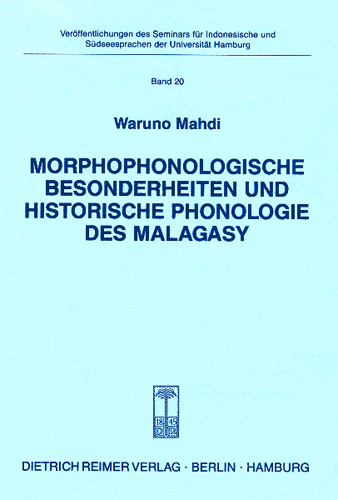 Morphophonologische Besonderheiten und historische Phonologie des Malagasy, Veröffentlichungen des Seminars für indonesische und Südseesprachen der Universität Hamburg 20. Berlin / Hamburg: Reimer (ISBN: 978-3-496-00933-0).Formal description of Malagasy morphophonology, particularly with regard to morphophonological processes at suffixation; introduces a morphophonemic transcription, disclosing suppletivism involving doublet cognates. A general study of the historical phonology of Malagasy, tracing back to Proto-East-Barito, and further up till Proto-Austronesian. Study of the origin and development of the morphophonological particularities of the language. Discussion of general problems of Austronesian historical linguistics and of subgrouping methods (particularly lexicostatistics and exclusively shared innovations).Reviews:
- Jan Knappert, in Bulletin of the School of Oriental and African Studies 53:395–396 (1990).
- K.A. Adelaar, "New Ideas on the Early History of Malagasy", pp. 1–22 in H. Steinhauer (ed.), Papers in Austronesian Linguistics No. 1, Pacific Linguistics series A-81, Canberra: Australian National University (1991).
1981 return to top Some Problems of the Phonology of Metropolitan Indonesian, Bijdragen tot de Taal, Land- en Volkenkunde 137:399–418.Investigates the loaned phonemes in Indonesian, which appeared as a result of borrowing from Sanskrit, Arabic, Persia, Dutch and other European languages, particularly /f/, /x/, /z/, /sh/, /?/, and /e/.
1976 return to top Бeзaфикcaльныe cлoвoфopмы-oмoнимы в индoнeзийcкoм языкe (Affixless homonymic Wordforms in Indonesian). In Teзиcы диcкyccии “Tипoлoгия кaк paздeл языкoзнaния”, pp. 118–120. Mocквa: Hayкa.
[preliminary text version]Proposes a method for distinguishing homonymic forms within the paradigm of a word of a given class (part of speech), based on the dependence of limitations in the realisability of characteristic valencies of words of that class from their functional position in the phrase. Distinguishes homonymic forms in the paradigm of the substantive and of the verb.
In prep. return to top Early word borrowing between mainland and insular Southeast Asia (between c. 1500 BCE and 1500 CE),
(monograph).A history of Latin-script Indonesian Malay,
(monograph).