| Date: | | February 2, 2019 |
| To: | | New York Times. |
| Subject: | | Maduro Warns That U.S. Intervention Would Create a Vietnam Nightmare
(NYTimes, Jan. 31, 2019, p. A6) |
|
Maduro is a surprisingly late victim of communist ideology, demonstrating his limited intellectual capacities.
His present comparative reference to the Vietnam War demonstrates this all the more.
Other remaining communist regimes learned long ago, that the only way to survive was to open up for capitalist business:
first China under Deng Xiaoping, then Russia under Mikhail Gorbachev, followed by the others.
The Vietcong’s guerilla war prevailed thanks to having North Vietnam as unassailable base that in turn had the full
political and material support of (neighboring) China. A “Vietnam” in Venezuela wouldn't have the slightest chance.
Having already brought great suffering to the Venezuelan people with his ignorant economic policy,
he is now threatening it with a total war catastrophe..
|
| Date: | | January 31, 2019 |
| To: | | Facebook / Peter Austin (January 30) shared “News Thump” article. |
| Subject: | | “Britain to repeat its Brexit offer loudly and slowly until
the foreigners get it” |
|
I can’t repeat often enough: the EU should agree to any further negotiations under the condition that a second referendum is made.
That would be the ideal solution. A second referendum would definitively say NO Brexit, and the matter can be discarded into the trash can.
|
| Date: | | 10 Dec. 2018 |
| To: | | TIME Magazine (Europe edition) |
| Subject: | | World: The friendly face of Europe’s new right (TIME [Europe], December 10, 2018, pp. 32–37) |
|
> Chancellor Sebastian Kurz couldn't beat Austria’s populist insugrents
> So he offered them a seat at the table.
The “good” news is: rightist populism is thus not a specific problem of the US. The bad news, however,
is that the phenomenon is apparently globalizing. At the same time, the involved leading politicians
resemble each other just as little as Sebastian Kurz and Donald Trump do.
This means that it is indeed not the populist politicians who are misleading the common people,
but a relatively recent cultural development that is causing rightist populism to spread in a
growing section of those common people. The politicians are merely making use of that.
There is doubtlessly more than one reason, but one development seems to remarkably coincide in
time and area of dispersal with that of rightist populism.
In industrial countries, so-called rationalism has been increasingly displacing traditional ethical culture,
be it religious or general behavioral. For example, it is allegedly stupid to stop before a red traffic light
when there is no traffic on the crossroad. Needless to say, it requires a certain degree of intelligence
and education to achieve a minimum of rationality. When one has gone through all the relevant factors,
one ends up with that section of society that is also involved in rightist populist movements.
|
| Date: | | September 28, 2018 |
| To: | | TIME Magazine (Europe edition) |
| Subject: | | Molly Ball:
“Supreme reckoning: Brett Kavanaugh's confirmation has become a
parable of political power in 2018”
(TIME [Europe], October 1, 2018, pp. 20–25) |
|
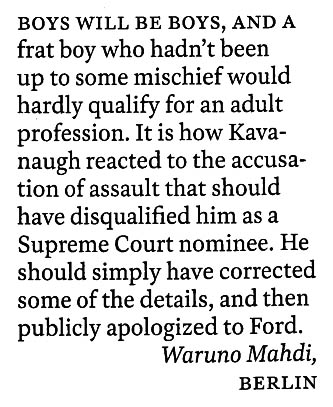
My letter was kindly publish in shortened form in TIME [Europe] of October 22, 2018, on p. 6.
|
| Date: | | July 26, 2018 |
| To: | | TIME Magazine (Europe edition) |
| Subject: | | Simon Shuster:
“Putin’s master plan to undermine Mueller”
(TIME [Europe], july 30, 2018, p. 27) |
|
In all the media news coverage about Robert Mueller's investigation and possible Russian interference in
the presidential elections I have missed one important, if not to say vital, point:
it makes Donald Trump an easy target of being blackmailed. Russian persons of interest,
be it Putin or some oligarchs, merely have to threaten to disclose some secrets, whether true or fake,
to get what they want from him. It no longer matters whether the Russians had indeed manipulated the elections.
They are now in a position to manipulate the US president.
|
| Date: | | February 8, 2018 |
| To: | | Washington Post online |
| Subject: | | Tara Bahrampour:
“They considered themselves white, but DNA tests told a more complex story”
(The Washington Post online February 6 at 7:37 PM) |
|
Scientists have long shown that “race” is not an objective reality, and speak of "“phenotype” instead,
when referring to peoples’ complexion. With regard to introduction of Sub-Saharan DNA amongst so-called WASP-s,
note that there were Sub-Saharan African soldiers in the legions of Julius Caesar stationed in Britain.
So it goes further back in time than most people might think.
|
| Date: | | December 12, 2017 |
| To: | | Facebook / Khir Johari shared Jewish Voice for Peace's post. |
| Subject: | | Netanyahu’s mistaken policy |
|
Netanyahu’s ultrazionist policy is stupid. Supposing Israel would indeed manage to expand over entire Palestine,
it would have a population with a way over absolute majority of Muslims. Under conditions of a democracy,
the majority of parliament members, and hence also the government, would be Muslim. To prevent that,
the Zionists would have to introduce apartheid, and how long that functions well we can judge from the history of South Africa.
Mind you, I quite explicitly speak of (Ultra)Zionists, because I have nothing against Israelis in general,
much less against Jews.
|
| Date: | | October 6, 2017 |
| To: | | Facebook / Waruno Mahdi |
| Subject: | | M. Berman, S. Somashekhar, W. Wan, M. Zapotosky:
“Las Vegas shooting motive eludes investigators as new details emerge about gunman Stephen Paddock”
(The Washington Post, October 5 at 6:06 PM) |
|
One point I am missing in the reports of the investigators is that Stephen Paddock perhaps suffered from Asperger Syndrome,
a mild variant of autism. Though often quite intelligent, someone with the syndrome has difficulty in communicating socially,
is often the victim of mobbing in his childhood or youth, may secretly harbor a vengeance for either factual or imagined injustice.
|
| Date: | | July 3, 2017 |
| To: | | Facebook / Omniglot |
| Subject: | | !50 years Canada |
|
My congratulations for the Canadian hundred-and-fiftieth anniversary.
Mes félicitations a le cent cinquantenaire de Canada.
A country without walls, and with open arms.
Un pays sans murs, et avec les bras ouverts.
How does one say this in languages of the first nations?
|
| Date: | | June 5, 2017 |
| To: | | Facebook / Waruno Mahdi |
| Subject: | | Jennifer Rubin: With his London tweets, Trump embarrasses himself – and America – once again (The Washington Post: June 4, 2017) |
|
I am deeply angered at yet another stupid hostility against peaceful people, this time again in London.
My respect to the people for fighting back and not letting themselves be intimidated by idiots running amuck.
I can only quote the following text from the
Washington Post:
<<The stoic determination and decency of the British people and their leaders were on full display
in the hours after the latest horrific terrorist rampage. The Brits fought back, launching drinking glasses
and chairs at the savages who attacked them. The police acted with lightning-fast precision, killing the
three assailants within eight minutes of the emergency call. And, God Bless him, a man returned to the bar
where he experienced Saturday’s horror – to pay his bill and tip. Civilisation is not going to be driven
out of Britain by three or three hundred killers.>>
|
| Date: | | May 27, 2017 |
| To: | | Facebook / Waruno Mahdi |
| Subject: | | Egypt: At least 28 dead as gunmen fire on bus carrying Coptic Christians (CNN May 26, 2017) |
|
My deepest condolences to families and friends of the Coptic bus passengers in Minya, Egypt,
victims of the barbaric attack of the alleged “Islamic State” infidel terrorists. It is important to stress,
that the terrorists do not represent any “caliphate”, but that when the Iraqi dictator Saddam Hussein was conquered
by the US under president Bush, the latter failed to take care of the former Iraqi army. It was the now unemployed personnel
of that army which made up the initial ranks of that “Islamic State”. They were not religious representatives,
but militaries who happened to be Sunnite Muslims. By missusing the reference to Islam in their criminal terror,
they are actually committing blasphemy!
|
| Date: | | May 24, 2017 |
| To: | | Facebook / Waruno Mahdi |
| Subject: | | Manchester arena bombing (May 22, 2017) |
|
My deepest condolence to relatives and friends of the young victims of the terrorist bomber in Manchester.
COMMENT (May 29, 2017):
Subject; James Palmer “I Love Manchester, But Please Stop Celebrating My Hometown” (May 24, 2017)
I have been deeply impressed by the courageous but unsentimental reaction of the Mancunians — as citizens of Manchester are known —
who do not allow the terrorist attack to bring them down. It is indeed the reaction of "the common people",
and deserving for that our respect all the more.
|
The policy of elected French President Macron will lead to greater security against IS terrorism,
while a victory of Le Pen would have increased the danger.
IS would have loved Le Pen to win, because her planned discrimination of Algerian and other immigrant citizens
would have greatly helped IS in recruiting terrorist followers.
With regard to Trump's policy in the US too, one must count with a criminal tendency amongst unjustly illegalised immigrants.
|
| Date: | | Apr. 8, 2017 |
| To: | | Facebook / Waruno Mahdi |
| Subject: | | Drottninggatan in Stockholm |
|
My deepest sympathies with relatives and friends of the victims of the faithless infidel idiot
that drove like he was the devil through the wonderful Drottninggatan in Stockholm.
COMMENT (2 hrs later):
I heard that the culprit has been caught and placed under arrest. Good.
Now it will come to a court trial, and I hope the Swedish state attorney will also call a
Muslim ulama as expert witness to declare to the face of the amok-driver
that his deed was a mortal sin.
|
| Date: | | Apr. 4, 2017 |
| To: | | Facebook / Waruno Mahdi |
| Subject: | | St. Petersbutg subway bomb |
|
My heartfelt sympathy for the victims of the stupid bomb strike in the St-Petersburg subway!
Obviously, there are losers everywhere, and they think they can avenge themselves by hurting others.
But the true reasons for their personal plight remains untouched, and so their deed only makes their loser condition complete.
|
| Date: | | Mar. 24, 2017 |
| To: | | Facebook / Waruno Mahdi |
| Subject: | | Westminster Bridge |
|
My wholehearted solidarity with my British friends.
May the godless amok-driver at Westminster Bridge smolder in hell!
|
| Date: | | Nov. 12, 2016, 2:17 PM GMT+1 |
| To: | | The Washington Post / Opinion |
| Subject: | | Garrison Keillor "Trump voters will not like what happens next" (November 9, 2016) |
|
Whatever one thinks about Donald Trump, one thing is certain: he is not stupid. Actually, he was clever enough to get nominated,
and then elected, in spite of having no previous political experience. But being a busessman, he knew how to sell.
As Winston Churchill already pointed out, free democracy is the worst political system one can imagine,
as long as one does not include the other existing systems. Educated people know this when witnessing the
negative aspects of free democratic politics. The less educated majority does not, and becomes easy prey of
populist demagogues when these call attention to those negative aspects. This is the more so with
modern mass digital access to (true as well as false) information.
Trump is now entering the political establishment, and learning fast (not stupid, see above).
In expectation of his voters' disappointment, he already announces he will retain Obamacare.
Let's see what further tricks he has up his sleeves.
|
| Date: | | 15 Jul. 2016 |
| To: | | FaceBook / David Gil |
| Subject: | | Obama vs Trump (June 16, 2016 |
|
> ... Though what's noteworthy is that while so many people have taken issue with my criticism
> of Obama and his position, nobody so far has leaped to the defense of Trump. _ _ But given
> that — in very rough ballpark figures — Obama and Trump each represent around half of the
> population of the USA, it's striking how skewed my pool of facebook friends is
By choosing to be an ethnolinguistic researcher, one also chooses one's circle of colleagues and friends.
Taking the freedom of having an own view of the world has similar effects. Nothing wrong with that I guess.
But as a field worker, it depends on where one does that work. Try doing field work amongst Trumpophyliacs
(or should I perhaps say Trumpomaniacs?).
As for Obama, I confess having been a supporter of his since his nomination, and then was very happy with
his being awarded the Nobel Prize. One event that I felt as confirming that, was the death of Osama bin Ladin.
Considering how the Repulicans have been doing their best to sabotage his work, they really deserve a Donald Trump.
|
| Date: | | 13 Mar. 2016 |
| To: | | FaceBook / Uri Tadmor |
| Subject: | | To Maintain Supply of Sex Slaves, ISIS Pushes Birth Control |
|
On one side, the Iraqi “government” is riveted by corruption and incompetence,
On the other side, Syria is ruled by the mishap son of a dictator who nevertheless knew how to rule.
The son is a complete nincompoop. So long as one is not even able to bring a semblance of
order in either of these two neighbors of ISIL, one stands no chance of coping with ISIL.
The only ones who are somehow managing to deal with ISIL are the Kurds. So guess what? Yes,
the only ISIL neighbor that is a member of NATO, is more busy fighting the Kurds.
Any more questions, anybody?
|
| Date: | | 12 Feb. 2016 |
| To: | | FaceBook / Uri Tadmor |
| Subject: | | Re: Vox: rise of Donald Trump is a terrifying moment (Feb. 11, 2016) |
|
To be frank, I was actually hoping he would get nominated. This would at least prevent that the next president is a Republican.
Previous ones, particularly the Bush-s, are responsible for the situation in the Middle East, particularly the rise of ISIL,
so the most terrifying moment I could imagine would be a third Bush as president.
> I used to wish he was nominated for the same reason, but now I'm scared he'll actually win.
Thank goodness, however, there is the establishment, and that will see that he doesn't become president. They'd sooner accept
even Bernie Sanders as president, even though I'd still bet on Hillary.
* P.S.: Sorry, I proved wrong, and he did get elected after all. Horrible!.
|
| Date: | | 17 May 2015 |
| To: | | FaceBook / Roger Blench |
| Subject: | | Re: Death sentence for Dzhokhar Tsarnaev (May 16, 2015, 10:41 pm ) |
|
One should decide first, if one is for or against death penalty.
I am personally against the death penalty, because it is irreversible, whereas judges,
attorneys and jurors are all human, and may err. Has anyone ever been sentenced
to death after it turned out that a carried out death penalty proved to be mistaken
and the prosecuted innocent?
|
| Date: | | 30 Jul 2011, 16:22 MET |
| In: | | Facebook |
| Subject: | | terrorist bombing in Oslo and shooting in Ùtøya |
|
Back after almost a week in Holland, just while the whole world was being horrified by that Norwegian bomber and killer of young people. And with that he even managed to get a super-long Wikipedia entry in less than a week:
click here
The comments rightfully condemned Breivik’s terrorist deeds, also placing some responsibility on right-wing populist parties and associations. But some significant points remain overlooked. Besides reasons for condemning him, there are some for thanking him: He demonstrated that (1) being a “jihadist” terrorist was neither an Islamic trait, much less an Arabic or Afghan one, and that (2) although mentioned right-wing populists were chiefly anti-Islamic, the underlying motive was being against multi-culturality.
Way back, being a “half-breed” or exile or emigré made you an outcast. With globalization, business representatives, scientists and students, NGO-workers, journalists, migrants, refugees, etc. a novel culture community of grown-up so-called “third culture kids” (TCK) is becoming globally predominant. It is the monolingual mono-ethnic “natives” that are finding themselves marginalized, and form the social stratum in which right-wing populists find their followers. They need help, so as not to become victimized by those populists.
Added on 1 Aug 2011:
But above all, I am deeply impressed by how the Norwegians gathered together as one, regardless of party or ideology, religion or origin. With that, the Norwegian nation collectively hit the terrorist more devastatingly than with any length of imprisonment.
|
| Date: | | 15 May 2011, 17:13 MET |
| To: | | TIME magazine |
| Subject: | | special report on the end of Bin Laden (Time-Eu. 177/20, May 20, 2011) |
|
In all the more than justified satisfaction and rejoicing over justice having at last been done, one shouldn’t limit oneself to an own perspective of the situation. For a greater durability of the achieved success, one must also see aspects that are significant to others, particularly to the Muslims.
First, one must not forget to stress that bin Laden is not, and never was, a religious leader. He was a financial businessman, and a not particularly successful one at that. His organisatorial role lay not in disseminating religious teachings, but in financial funding of terrorist activity that mainly victimized civilians, for the greater part Muslims.
He is therefore definitively not a martyr, much less a hero. At the decisive moment of showdown, even raising his hands to surrender apparently demanded too much manliness from him. His intuitive reaction was to duck behind his young wife. What a coward!
Second, as organiser of terrorism against the United States that he declared alleged enemy of Islam, bin Laden proved himself totally incompetent and insightless. Hitting NY WTC on 9/11 was maybe quite spectacular, but to hit US business, the real target should have been Wall Street. The WTC was, on the other hand, an international center that housed representations of foreign banks and companies.
Had he wanted to hit the US military, the Pentagon would have been the central target for two or more planes, instead of a subordinated with just one; maybe also the CIA HQ at Langley. If he wanted to hit sin and vice, that would have been perhaps gambling centers in Las Vegas, or production of porno videos in LA.
But he missused the religious self-sacrifice of young followers on a center of international business representatives, or just as senselessly on the White House, and that when the President was not home! And this brings us to the perhaps most ignominious aspect of his doings.
Harboring personal failure-based sour-grapes hatred against the US, he sought support in the most backward and primitive circles of Islamic fundamentalism. He then succeeded in brainwashing frustrated young Muslim intellectuals to sacrifice their lives as suicidal pilots and bombers. This he wasted on above-mentioned and other senseless targets having no strategic value at all, other than to upbolster his own ego. The true main victim of bin Laden's activity was therefore the Islamic community and its young hopefuls.
At first sight, President Obama owes his present breakthrough to the courageous action of Navy Seals Team 6. Actually, this was the successful consequence of a lengthier policy. The revised strategy of US foreign policy since President Obama took office has changed the image of the US in the eyes of the Islamic middle class and intellectual youth alike. They have stopped seeing the US as potential threat and enemy. Consequently, they are no longer afraid to raise their voice against authoritarian potentates who, in turn, can no longer missuse the US as enemy image to keep their subjects in line.
Muslims all over the Middle East have become encouraged to openly recognize the US as ally in their struggle for democracy. They are consequently no longer so easily manipulated by the likes of bin Laden. Al-Qaida is gradually loosing its inner compactness, and this opened the leak that made the Team 6 action in Abbottabad at all possible.
Sincerely,
Waruno Mahdi
|
| Date: | | 11 Dec 2010, 16:02 MET |
| To: | | TIME magazine |
| Subject: | | The War on Secrecy (Time-Eu. 176/24, Dec. 13, 2010, pp. 20-24) |
|
One may be either for or against secret information being leaked when it concerns internal matters of banks and business companies, financial, military, or other government agencies, even secret sevices. But leaking classified diplomatic cables is an immeasurably more fundamental and absolutely unpardonable violation. Respect for the secrecy of the diplomatic mail is an international tradition that is just as sacrosanct as not shooting at messengers carrying the truce flag.
With regard to the US diplomatic cables in WikiLeaks, their contents might seem intriguing to the layperson, but is quite déjà vu for anyone who ever had something to do with diplomatic life. Their style and nature does not differ from that of reports of diplomats of any other country. Diplomats on site collect all information and gossip they can get, including any personal opinions based on that, and it is up to the foreign office back home to decide on credibility and in what respect it may seem useful.
In violating the secrecy of diplomatic mail, Julian Assange perhaps acted out of ignorance, but unknowledge of the law does not free one from abiding by it.
Sincerely,
Waruno Mahdi
|
| Date: | | 14 Sep. 2008 |
| To: | | The International Herald Tribune |
| Subject: | | Do Palin's credentials compare to Truman's? |
|
If John MacCain really wants a change the way Barack Obama does,
he'd hardly have nominated Sarah Palin for VP.
She is definitely not the GOP answer to Hillary Clinton, her
qualifications make her more like the female equivalent of George W. Bush.
So, if coming November the American voters should choose McCain
after all, we can only pray to God that He'll let him hold on
the full four-year term.
Sincerely
Waruno Mahdi
|
| Date: | | 28 Aug 2008, 16:02 MET |
| To: | | TIME magazine |
| Subject: | | Five faces of Obama (TIME, 1 Sep 2008) |
|
Re your cover story "Five faces of Obama", you left out the perhaps most
important alternative: that of a leader. The US as sole remaining
post-cold-war superpower need all the international support they can get to
successfully play that responsible role. A great deal was achieved during
the Clinton administration, but that was almost put to naught under
George W. Bush. As macabre as this may sound: it was only "thanks" to
9/11 that the world at least halfheartedly rallied back around the US.
Barack Obama as president has an important message for the world:
"we are your leader of choice, not because our army is stronger, but
because we represent you all and your aspirations for freedom".
Sincerely,
Waruno Mahdi
|
| Date: | | 14 Dec 2007, 17:26 MET |
| To: | | TIME magazine |
| Subject: | | Now they Tell Us? (TIME, 17 Dec 2007) |
|
When I was seven, and living in Bangkok, my parents sent me to the
American school that was there. One thing I remember is the story of
the shepherd boy who cried "wolf!". After the world had to swallow the
Iraqi wmd hoax, and then that of the Iranian nuclear weapons, what if one
day there should really be a global threat, but nobody takes it serious?
I wonder to what school Mr. Bush Senior sent Mr Bush Junior when the
latter was a kid? Weren't there any proper American schools in the
vincinity?
Sincerely
Waruno Mahdi
|
| Date: | | 11 May 2007 |
| To: | | Houston Chronicle |
| Subject: | | Vietnam Syndrom (editorial of May 10, 2007) |
|
Thank you for the very insightful editorial on the war in Iraq and its
possible perspectives and consequences. There is only one inaccuracy
perhaps, when you assume that "In Iraq, the United States again is allied
to a democratic government that cannot successfully defend itself".
The regime in South Vietnam was not democratic by any standards, and
having to defend it was merely necessitated by circumstances of the
cold war of that time, to forestall further expansion of the communist
block. In Iraq, the government may formally seem to be democratic by
most standards, but it suffers from the circumstance that it was formed
without adequate understanding of how democracy works.
Modern democracy is the government form of choice under conditions of political
supremacy of the middle class (it won't function otherwise), and requires
the collective insight of all involved parties that any missuse of power,
be it military, economic, judicial, or other, would lead to grave loss on
the part of the missuser itself in consequence of the destabilization the
whole. It is thus a collective compromise (I would even use the word
"conspiracy") that secures the optimal economic conditions to let private
initiative and business flourish. The interest in that of the middle class
is the intrinsic condition that makes democracy feasible.
At formation of the Iraq government, that was left to remain unclear to most parties.
Unlike Afghanistan, Iraq fortunately has a rather well developed middle class
in all three of its ethno-confessional communities (Shiite Arab, Sunnite Arab,
Sunnite Kurd), but initial tactical mistakes of the US forces actually quite
directly antagonized (without real reason) some of the parties that should have
been brought together.
With regard to ways out of the present predicament, the Baker Commission seems
indeed to have formulated the principal points (I only disagree about cutting
Iraq in three: when there is no discrimination, a developed middle class aptly
bridges ethnic diversity, because additional boundaries are not in interest of
business and trade). Unfortunately, however, some recent undiplomatic
expostulations of the present president will probably make soliciting for the
indeed prerequisite Syrian and Iranian cooperation "too expensive". Furthermore,
after the end of the cold war, there was quite a fascinating renovation of expertise
in the rank and file of US government ministries and agencies with regard to foreign
affairs and development, but this came to a standstill with the coming of the present
admnistration. We must therefore perhaps indeed wait for the next president in the US,
before peace comes to Iraq.
|
| Date: | | 20 Jun 2005, 18:26 MET |
| To: | | TIME magazine |
| Subject: | | Inside the Interrog. of Detainee 063 (TIME, 20 Jun 2005) |
|
Forget the weapons of mass destruction, the other and perhaps more
significant argument put foward by President George W. Bush to attack
Iraq was "freedom". But with Gitmo threatening to ecclipse memories
of Gulag, I begin to wonder whether the CIA will now get the blame
for failing to correctly brief the President on the meaning of the
word "freedom". Is this really what the free world is all about?
Sincerely
Waruno Mahdi
|
| Date: | | 16 May 2005 |
| To: | | The Washington Post |
| Subject: | | 'Martyrs' In Iraq Mostly Saudis (WP, 15 May 2005) |
|
I wonder when somebody will start setting up websites describing
the plight of common innocent Iraqi victims of those self-styled
'Martyrs', and of their orphans, parents, widows, etc. Of course,
the appearance of such sites requires some human interest for the
common Iraqis as a precondition to begin with.
Sincerely,
Waruno Mahdi
|
| Date: | | 3 Nov 2004, 12:10 ME |
| To: | | Indonesian language list <Bahasa> |
| Subject: | | Javanese instructor |
|
> may Bush be ousted
Well, if they put that bungler another 4 years in office, that's four
more years than necessary that we'll be stuck with al-Qaida terrorism,
I'm afraid.
Ohio, all our hopes are with you!
|
| Date: | | 11 Oct 2001, 16:05 MET |
| To: | | TIME magazine |
| Subject: | | Afghanistan |
|
The presently being considered solutions for a future Afghanistan
involving the Northern alliance and the ex-king will not function.
They will only put the country back to the situation that made
it ripe for the Taliban takeover.
The only solution that will work is dividing the country between
its neighbor countries. Unite the Tadjik, Uzbek, Turkmen, and
Kirghiz-populated areas respectively with Tadjikistan, Uzbekistan,
Turkmenistan, and Kyrghyzstan, leaving the Ismaeli, Nuristani,
Pathan, Beluchi and Pashtu populated areas including Kabul to be
united with Pakistan. The allocation of the Hazara either to
Pakistan or to Tadjikistan may need further consideration.
Afghanistan is still a conglomerate of early-feudal warring chiefs,
so there will not be serious internal resistance against a break-up
of Afghanistan. The Northern peoples even now are looking up to
Tadjikistan, Uzbekistan, Turkmenistan, and Kyrghyzstan for help in
their predicament, and would be happy to be permanently rid of the
threat of future transgressions by the Pashtu.
The Pashtu are even now fleeing in millions to their co-tribesmen
across the border to Pakistan, and will be happy about the
elimination of the present international border that arbitrarily
cuts their distribution area.
Most important from the current tactical point of view, it solves
all problems Pakistan has for supporting the US. The pro-US
government would not be happy with an Afghanistan under rule of
the present North Alliance. On the other hand, the territorial
accretion would be the perfect quench against all fundamentalist
critics that are making life difficult for the government.
..........
|
| Date: | | 18 Mar 2001 |
| To: | | indonesia-act (mailig list) |
| Subject: | | re: New military operations in Aceh and the ExxonMobil factor |
|
> ExxonMobil's announcement that it was suspending operations in Aceh because
> of the security situation came within hours of the announcement in Jakarta
> on 12 March that the Wahid cabinet had formally branded GAM as a
> 'separatist movement', giving the armed forces the go-ahead to carry out
--corrected:
> 8 March, four days before the cabinet's decision to launch 'limited
> military operations' in Aceh, not 'within hours of the cabinet
Indeed, the fantastic nimbleness of the Indon. government to even react
preemptively (hours BEFORE) would alone have signified a major revolution.
But even as it is, the already amazingly prompt "four days after" clearly
demonstrates the nervousness of the Indonesian elite, for heaven's sake
not to unfavourably impress the new Washington administration.
(otherwise they wait till the number of victims exceeds 400 dead before
raising an eyebrow).
The howler of the day, that the Indon. govt. at last noticed that GAM is
a separatist organization, on the other hand, should probably not be seen
as testifying to particularly slothful data processing, but more to
formulational ineptness (a perennial problem since the school for diplomats
set up by Haji Agus Salim - Carmel Budiardjo was one of the English
teachers - was dissolved by the Soeharto regime).
As for apprehensions with regard to political handicraft on the Potomac,
these may perhaps understandable - I think too, that Bush Senior made two
grave mistakes in Irak: he started a war when he shouldn't have, then
he stopped it without bringing it to the logical end. But it doesn't
seem productive to speculate over whether Colin Powell might or might
not have learned from that experience. Anyway, the most widely spread
Washington insider secret these days is that rumours of Bush Junior's
alleged intellectual simplicity are a gros disinformation.
The US establishment went through an arduous process of reassessment of
objectives and values since the end of the cold war, as it began to
appreciate consequences of its responsibility as sole superpower. Now,
this may indeed have mainly proceeded under a Democrat administration,
but that which has been replaced is the president and his cabinet, not
the expertise-carrying ministerial and diplomatic rank-and-file. So, as
always, one must not regard past opposition slogans as too programmatic
for policies after change-over to government. Beside that, House and
Senate are pretty evenly divided, making insufficiently worked out
unilateral decisions reassuringly difficult to set through.
With special regard to Indonesia, the really neat enactment of feeding
that Washington Post editorial in manipulated form to the Indon. press,
about the US govt. contemplating reinstalling the Indonesian military to
power, followed by elaborate official denials, was simply 1A.
It electrified the entire Indon. military and civil establishment into
top gear, all ears and antennas spread wide to catch the faintest hint
of a wish from Uncle Sam.
To evaluate the significance of any situation in politics with regard to
future perspectives, it seems to usually help if one simply assumes that
all sides will do what is in their respective best egoistic interests,
provided they are bright enough to figure out what that is, I think.
One shouldn't let oneself be fooled, of course, by recent reassurances
of military speakers that they have turned a new leaf and now require
additional authority to be able to warrant peace and security in troubled
regions, after having been lambasted for failure to react in Central
Kalimantan. A summary review of the past years will reveal that this is
the n-th replay of a relatively stale old tune they have grown used to
getting away with. But this time, they may be in for a surprise, at least
in Aceh.
Up to now, they were nominally responsible to the Indonesian state, that
means factually to noone other than themselves. So they were free to
"pacify" in a fashion that either pushed the population into the arms of
the rebels, or invoked the kind of peace one finds in cemetries. Now they
have to perform to the satisfaction of Exxon and Uncle Sam. But Exxon
does not run its gas and petroleum works for the fun of it, and I imagine
that every day of non-production means tangible losses to the company.
Companies the size of Exxon have means to express their dissatisfaction.
They want results, and will hardly be inclined to be as apologetic of
military bungling as the Jakarta establishment has been obliged to be.
They will hardly be able to resume production with dead or rebelliously
outraged workers, or at scorched installations.
So perhaps we should simply sit back and watch the militaries extricate
themselves out of the predicament into which they have so enthusiastically
plunged themselves headlong. Who knows, a stricter master with means to
set its will through may perhaps work wonders on the military.
I anticipate the logical objection, that the military has already been
used quite effectively by large companies as police against protesters
and the population in general. But even if Exxon would be satisfied with
that, it would already be an improvement. At least, the Acehnese get a
spell of peace for a change. But in fact, one has come along a bit further
now, particularly in the course of the US reassessing its role as superpower.
Anyway, whether it is Exxon in Aceh, or Freeport-McMoRan in West Papua, they
will have to gather the same lessons in responsibility as Shell in Nigeria.
The more one globalizes, the more the world becomes one, and thoughtless
policies at one end of the world have repercussions at the other, also at
home.
Not that such things happen on their own, of course, and Shell too used
a good deal of convincing from Greenpeace. But that is, after all, the
actual objective, not to put the Shells and Exxons out of business, but
to get them to operate in an acceptable responsible fashion. Ultimately,
in their own interests.
Salam, Waruno
|
| Date: | | 18 Sep 1998, 20:17 MET |
| To: | | TIME magazine |
| Subject: | | Reaping the Whirlwind (TIME, 21 Sep 1998) |
|
If ever the world needed prove of the power of Internet and World Wide Web,
then this monstrous self-outing of the hypocrisy of bigotry through a
worldwide broadcast of hardcore porn by Congress has provided it. Bravo!
But this demonstration of small-town provinciality and total lack of state
responsibility by that Congress is a slap in the face of all your friends
around the world who, since the end of the cold war, were preparing to
greet a matured United States leading the way. For all their bigotry,
these congressmen don't even reach to the groin of Bill Clinton’s
political stature.
What consenting adults do behind closed doors is their private business,
and the same actually held for all US presidents since George Washington
(including John F. Kennedy). Now since this “independent” investigator
decided to cover up his failure in the Whitewater investigation by raising
a peeping Tom’s favorite pre-occupation with keyholes to the rank of a
40-million dollar official state investigation, he has also converted a
gentleman’s subterfuge to protect a lady’s name into “perjury”. But as what
these two were doing was none of his business anyway, he had no call to
question the president on it to begin with. Whatever answer he got, whether
true, untrue, or half true, is totally irrelevant.
Send Kenneth Starr to investigate vice in Tuskaloosa or somewhere, and let
Bill Clinton concentrate further on the magnificent job he is doing as
president. Pity he can’t be had for a third term.
Sincerely
Waruno Mahdi
|
| Date: | | Thu, 15 Oct 1998 19:18 MET |
| To: | | EastNet mailing list |
| Subject: | | Re: Noam, the Media, Clinton, and
the Great Conspiracy |
|
[.....], [.....], [.....]
One aspect of capitalism is the principle of free competition, not only
on the market, but also on the political arena, that denies any
absolute and supreme authorities. The other, complementary aspect of
capitalism is its principle of self regulation, which compensates the
absence of that absolute authority. These are the two fundamental
organizational principles of a functioning capitalism. They are not two
independent principles, but are mutually dependent. How can this be,
and how does it function?
The principle of free competition is responsible for its effeciency,
as the best product or policy gets to prevail over the less efficient
alternatives. In theory. In detail, this may not however always be so.
A very trivial example are addictive commodities. Theoretically,
one should legalize narcotics, because forbidding them would seem to
be an authorative intervention into the free market economy.
If narcotics are bad (they are!), they won't sell.... Unfortunately,
they cause addiction, and addicts are willessly compelled to go on
buying the stuff in spite of knowing that it is ruining their health.
Allowing the health of substantial parts of the population to be ruined
leads to disruptions in other sectors, and as an ever larger sphere of
interests suffers from the real or potential damage, this finally leads
to the formation of a sufficiantly influential collective will to
illegalize the narcotics.
Not a supreme authority standing over the community decides this, but
an authority that was delegated by the community, acting on concrete
convictions that had formed within the community with regard to a certain
concrete problem. It is important to note, that this voluntary delegation
of authority was inevitable. Freely competing legal narcotics dealers
cannot be expected to voluntarily stop dealing. When the one stops,
someone else will take his place, and the former ends up as the dupe.
The community has no other choice but to produce an "independent"
authority that enforces the prohibition of narcotics (unfortunately,
even this is not effective enough).
The functioning of this mechanism is of course even more important in
mainstream or vital aspects of the economic process. Population
growth or other factors may lead to a surplus of manpower, which
makes it possible to turn the screws on labour (whoever protests gets
sacked, there being an army of unemployed who'd gladly take his place).
In the long run, this leads to deterioration of health and qualification,
and it is within the interests of the employers, that an independent
organized representation of labour is legalized as counterbalance.
But this cannot be developed voluntarily by individual employers,
because letting labour becomes more expensive in their own enterprises
makes them less competitive than the less conscientious "black sheep".
Like in the example of the narcotics dealers above, they need that
government to which they have delegated sufficient authority to
introduce the necessary legislation and then enforce it.
It is not possible to go into all the details of how this functions,
and how it permeates the entire economic system. We must note here,
that (1) this form of government which acquires its authority in
that this is delegated to it in a continous process of periodic
democratic legitimation by free elections and consultative consensus
formation is directly conditioned by the free, "anarchic" nature of
this economic system, and (2) it is prerequisite for the smooth and
efficient functioning of that economic system (capitalism).
What's all this got to do with our discussion? Sorry this is so long
winding, but it is essential for the conclusion what I'm driving at.
That "free and democratically elected" government, is and can in
reality not be more and also not less "free", than the "free press"
we began this all with. When I say that the authority is "delegated"
to this government (and not maintained and enforced by terror of secret
police or monopoly on weapons etc.), I meant that quite literally.
They might like to house themselves in architecturally bombastic
buildings for representative reasons, let themselves be driven in
expensive limousines, surround themselves with all kinds of other
ceremony and luxury, but don't let that fool you: they are not the
predatory kings, princes, and other tyrants or despots of
traditional pre-democratic systems.
Just like the "free press" being "owned" by the financially powerful,
and being once more dependent from these for paid commercials and adds,
so too are politicians "owned". They are dependent on dotations from
the business world, and they are dependent on favourable coverage in
that "free press" which the latter "controls". But just as that this
doesn't make the press the willing puppet of big business (or not
necessarily so), so too for the political class. This latter acquires
its freedom from the same kind of interest conflict of their "owners".
Firstly, it is nice for them when the government does what business wants
them to do, but if that causes them to lose support of the public they
lose the next elections. Secondly (and more important), as we could see
above, business needs government to provide orderly conditions off business,
and this often includes enforcing regulations which may run against
the very interests of individual businesses.
I think we can conclude so far, not only that functioning democratic
government as we know it is an essential feature of functioning capitalism.
It is a prerequisite feature of this economic system. The curious
conditions under which this government functions, in which authority is
delegated to it by the very interests over which it must govern (like
the dentist whose fee we must pay for letting him painfully extract
our molar) is directly conditioned by the particular nature of this
economic system which is characterized by a free competition of forces.
The successful functioning of capitalist economy is at the same time
dependent on the smooth functioning of that singular mode of government.
And here we come back to the free press, which plays a not unimportant
role in maintaining that smooth functioning of democratic government.
If earlier we noted one opposition of interests, providing for a latitude
of freedom for the press in spite of financial control by business, here
we have another one. Smooth running of the economy is vital to the interests
of business, and insofar as this depends on a smooth functioning of
democratic government, it also depends on the functioning of a free press.
Business doesn't need sycophants, because it is quite capable of praising
itself, and also does so without stop in its public relations work.
It needs a free press and a democratic system of government for handling
the critical questions which can be just as painful as getting one's molar
extracted without anaesthetics, but also just as necessary nevertheless.
One classical case, in which government must take measures that are
"unpopular" among the most influential part of big busines, is perhaps
the introduction of anti-trust legislation in all advanced industrial
countries. Because, one fundamental aspect of free enterprise and free
market that makes it so efficient, is free competition which lets
the better product or better service win. This leads to concentration,
which in itself is not bad, because it is needed for development and
implementation of sophisticated (read: expensive) technology. But if
concentration is allowed to advance beyond a certain limit, it reaches
market controlling magnitude, and that cancels out that very competition
which underlies the efficiency of the system. The entire community
including its industry is stuck with an inferior product, because its
producer controls the market and can suffocate any competitor offering
a superior alternative.
As we advance from primitive capitalism to advanced capitalism, we
are ever more confronted with the interest conflict between companies
which strive to monopolize the market, and the community as a whole
(including business) which must rule out such monopolization.
The two interests are interdependent. Even the greatest monopolies
depend on sales. If a ruined community can no longer support increasing
sales, the company loses, perhaps even more than if it had not
monopolized the market to begin with. Apart from that, the national
economy loses when an inferior domestic product depending on monopoly
suddenly has to face up to a competitive foreign product.
As wealth concentrates at the top, it is always important to recycle
it downwards. Because, as already the ancients of antiquity kept
reminding, you can't eat money. Money is only good for three things:
| 1. |
to buy stuff that makes your life more pleasant (including food,
luxuries, etc.). After a certain ceiling, this is satiated, and more
money doesn't lead to greater enjoyment of life. Eating more caviar
makes you sick, ditto wearing half a dozen mink coats over each
other. And what good is having three instead of two dozen Rolls-Royces
in your garage? |
| 2. |
to secure one's position of immunity and influence within the community.
This is not a function of one's absolute wealth, but only of one's
relative wealth in comparison with the wealth of others against whom
one needs to defend one's position of influence. |
| 3. |
to make even more money, which only makes sense if it serves one
of the aims touched in items 1 and 2. |
As the natural course of development causes ever more wealth to
concentrate at the top, this inevitably leads to stagnation,
because decreased wealth below decreases buying power, whereas increased
wealth at the top does not increase consumption there (see item no. 1).
This can only be remedied when part of the wealth is ducted back
downwards. This does not harm interests of the "upper ten thousand" if
conducted in correct relation, without disrupting the respective interests
conditioned by item no. 2 above. But it keeps the economy running
so that the wealthy can go about their favourite sport as indicated in
item no. 3, and the "rabble" doesn't get restless and start sporting
all kinds of wild ideas like rebellion, revolution, nationalization, etc.,
or find itself compelled to resort to crime as means of subsistence
(can be rather unhealthy for the wealthy, and is in any case troublesome,
because of all the extra security measures one has to live with),
or become increasingly susceptible to infectious diseases (exposing
also the wealthy to increased health risks).
[.....]
(for the complete text, click here)
|
| Date: | | Sat, 22 Aug 1998 19:22 MET |
| To: | | EastNet mailing list |
| Subject: | | Re: Protest US Bombings |
|
> The problems of the Middle East are so complex that I shrink from touching any
> of them. And yet I must say that from a strictly Arab point of view it is
> crystal clear that the state of Israel is simply a US-sponsored usurpation of
> Arab rights and Arab lands. So while I condemn the methods used, I certainly
> understand the reasoning behind them.
You should go back to your history books again I think. Israel wasn't
US-sponsored, even if Jews in the US might have had an important role
in the entire zionist movement of that time. I think a lot of people
share guilt for what became of the Palestinians.
One can understand the Jews after the WWII holocaust, wanting to return
to a homeland of their own, but that obviously didn't give anyone the
right to chase the Palestinians off their lands. The British (not the
Americans) who were in charge at that time might have organized some
more intelligent solution. But perhaps it is always simple to criticize
afterwards. Actually, Israel would never have succeeded the way it had,
if not for the fact that Arabs were much more interested in fighting
against each other, rather than for Palestina. Not very likely that
they would accept that bit of guilt of course, particularly not since
the US has so consistently been offering itself as convenient scapegoat
all the while.
Indeed, the US has always had a vested interest in the area, and that's
kept them being vulnerable all along. The magic word is OIL!
At first, keeping the Arabs divided against each other meant continued
control over the oil wells. Later, after the oil crisis and the emergence
of OPEC, when oil producer countries could dictate the oil price, catching
the US on their wrong foot just after the debacle in Nam, keeping
the Arabs warring each other guaranteed that they would pump back all
those petro-dollars straight to the industrial nations again to buy arms.
That's the US main interest here, not Israel.
But Israel comes into the picture under a different aspect. As paradoxical
as this may seem, but, just as much that mutual dissent among the Arabs
has prevented that the Israelis were driven into the Mediterranean, so
also does final survival and wellfare for Israel (and Palestina!) depend
upon mutual peace and cooperation between the Semitic nations. But this,
I think, is what everybody else has always been and continous to be real
scared about.
A couple of years ago, some people asked me whether it would be prudent
or safe to invest a lot in China. I told them, that the main mistakes
most people made in appraising China as a potential place for investments
were (a) they saw it as some normal Asian developing or threshold country,
and (b) they saw it as just another socialist, East-Bloc state. But, when
one decided to give up socialism in Russia and start setting up capitalism
there, this resulted in a total collapse and beginning anew from scratch.
China is different. To understand China, imagine Israel and the Arabs
united in mutual consent as one state. China has an enormous, highly
educated and very wealthy diaspora, just like Israel, but it is as large
as, and even more populous than all the Arab countries taken together.
And it looks back on a civilization that could well stand up to the
Near East in ancienity. Chinese Emperors held relations with Babylon!
China can't collapse the way Russia did. Technical and capital resources
of the Chinese diaspora all over the world would close in to save the
homeland.
Now, if we just turn the tables around, you'll realise that it has been
very important throughout the cold war and also after it, for a lot
of people to see to it that the Jews and the Arabs didn't patch up their
differences. Because Jews and Arabs united would mean another China
right slap before Europe's front door, only that they would be even
richer because of Arab oil, and that because of the Jews, and more
recently also the Sheikhs, Western financial centers are already to
some certain degree in their control anyway.
If one wanted to, one could very easily reconciliate Jews and Arabs
with each other and set up self-sustaining peaceful relations between
them. There is just one key question to be solved, and it is one that
can be solved relatively easily. All the other problems then get
solved automatically. But that key question is never touched upon,
as though it were the greatest taboo of all times. Even when they
killed Rabin, neither friend nor foe dared touch upon it. (the reason
why he was bound to get killed one way or the other, was in my opinion
that he dared to seriously contemplate reaching a peace treaty without
having that key question solved).
Will one someday permit Jews and Arabs to reconciliate? I think there
is all the chance that they'll be forced to do so in not too distant
future. I don't think one can stop the development in China. Now imagine
an East Asian economic power centered in China, coupled with Japanese
capital and Southeast Asian natural resources. There'll be nothing to
set up against it. Already now, how much of American and European economy
is in Japanese hands? They'll have no choice but to allow for a
Jewish-Arabic Near Eastern center to counterbalance the Far Eastern one.
And what's that key? It's the Israeli national debt. So many years
of war and confrontation with numerically overwhelming Arabic opponents
has led to an astronomical national debt, which no democratic government
can force its population to carry under peace conditions. Only the
constant threat of war keeps this national debt manageable. The solution
is therefore a gigantic petro-dollar loan of the Arabs to cover the
Israeli national debt. The Arabs wouldn't need to be afraid of Israel
anymore, because they would practically own it. Israel wouldn't need
to be afraid of the Arabs anymore, because it is bad policy to bomb
or kill your debtors (you never get your money back).
This would immediately open the way for a Pan-Semitic integration, in
which the Palestinians would inevitably and automatically take the
mediator role. Palestinians are already the Arabic nation with the
highest average level of education and technical expertise. They also
already have an educated and wealthy diaspora (though not nearly comparable
with that of the Jews or Chinese). But the decisive circumstance here
is something else:
Where do Indonesians go when they go to Europe? (answer: Holland),
where do Pakistanis/Indians go when going to Europe? (Britain), and
where do Vietnamese, Cambodians, Laotians go? (France). Former
colonial masters are the favourite Europeans of the former colonies.
(One problem the Turks have with the Germans could be that
they'd never been a German colony). The same also holds vice versa:
the favourite Asians of the Dutch are Indonesians, of the British are
Indians and Pakistanis, etc., etc., ...
Why? The relationship between colonial master and colony is just as
intimate as in forced marriage. After a while you grow accustomed to
each other and even get to love the bastards. You in any case know more
about each other than perhaps even about yourself.
Ditto Palestinians and Israelis. Once peace is restored, whether the one
gets full independence, or a greater or lesser degree autonomy, would only
be a formality. After one or two generations, they'll be in each other's
arms and there'll be no way to separate them, with Arabic petro-dollars
tied in Israel, and Israelo-Palestinian technical experts and specialists
infiltrating the economies of the whole Arab world. Even today,
Palestinian technicians and experts are all over the place there, and
highly valued for their know-how. As for the Jews, they had always
felt quite comfortable and were well treated in the Caliphates. That
enabled them to become mediators transmitting Arabo-Islamic science
and technology to Renaissance Europe.
Once peace is restored, and Israelo-Palestinian experts infiltrate the
Arab world, domestic Arabic business capital would no longer be idle,
only finding application in buying up Europe, America, or jetfighters
and tanks. That capital will suddenly find application at home, and
once that happens, the command will move from the hands of the more
or less dictatorial heads of states into the hands of businessmen.
(Arabs are great business people per long tradition!). Many ambitious
politicians leads to war. A lot of busy businesspeople doing business
with each other is the best imaginable guarantee of peace. They'd
be totally puzzled if you asked them whether they knew what "jihad"
means.
Simple, isn't it? :-)
Aloha, Waruno
|